HTML/JavaScript

Wednesday, May 19, 2010

Sunrise Tofu Dessert: Caramel Custard Flavour

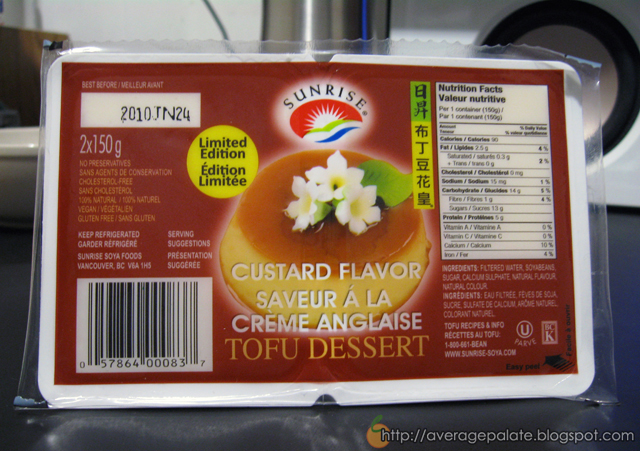
I found Sunrise flan (crème caramel) flavoured tofu dessert in the fridge the other day, which was a little confusing for me, mainly because I thought this only existed in my head. I never thought my custard tofu idea was a good one, but I was excited nonetheless.

Sunrise Tofu Dessert, Flan Caramel Custard Flavour

It basically tasted like tofu dessert with artificial caramel flavours, which actually tasted a bit like real caramel (obviously, it didn't have the depth or complexity). Supermarket flavoured versions of tofu dessert never quite win me over, but this was at least fun to try.

Sidenote: Anyone else think that the easy peel corner is not so easy, but rather frustratingly difficult?

Saturday, May 15, 2010

Forgotten Foods

In the spirit of nostalgia, I present foods from another time.

Jimmy's Chinese Style Beef Jerky used to be ubiquitous around Canada and the US. For that reason, it's surely a part of many of our childhoods. Over 5 years ago, it became impossible to find. A quick google of Jimmy's Fine Food Ltd. gives a relevant phone number (604-254-6616). Sadly, many jerky mourners have called this number, without success, indicating that the company is indeed out of business. I feel sorrow that I'll never get to taste this paper thin treat again, but at least I know I'm not alone.

Jimmy's Chinese Style Beef Jerky

Orbitz is an instantly recognizable drink that was produced by the Clearly Canadian Beverage Corporation. The concept was cool. Surprisingly, the suspended edible balls made the drink look refreshing. Unfortunately, I don't think I've ever tried the product. One thing for sure is that despite whether or not you've tasted it, most people will remember seeing the product at 7-11. If they ever bring it back, I would buy it just to satisfying my childhood urge to drink a lava lamp (I bet you've made the same association).

Orbitz

The Clearly Canadian Beverage Corporation also produced a glass bottled flavoured sparkling water. The product was widely available for a time and then fell out of popularity. While it is still produced, the classic glass blue bottle is gone and I doubt that the product is the same. Moreover, it doesn't seem like it's widely distributed at all.

Clearly Canadian Flavoured Sparkling Water

I have fond memories eating at McDonald's with the older decor (unlike now, where some of them are more contemporary than a condo). I remember the excitement as a kid waiting 10+ minutes for a McDonald's personal pizza. Unless they bring it back, I'll never know if it was the pizza that was awesome or if it's just because I miss my childhood.

McDonald's Pizza, McPizza

Cadbury's Astros were like big Smarties with a biscuit center after the milk chocolate. The biscuit part was sort of like Maltesers or Whoppers. They used to run ads on TV and I distinctly remember going to the local corner store ever so often to buy a box of them. From online searches, it appears this product is still available in South Africa, of all places.

Cadbury's Astros

Friday, May 14, 2010

Bo Laksa King

I felt hungry the other day and noticing that Bo Laksa King had their new website up, I thought it'd be a good idea to finally try them out. A word of note: their website lists that as of May 15th, their prices will no longer include tax, so there's going to be a bit of a price increase.

Bo Laksa King (inside Joyce-Way Food Market)
4910 Joyce St
Vancouver, BC V5R 4G6
(604) 339-0038

The roti canai ($5.99 for a large) is quite oily, including the curry chicken dip. This isn't necessarily a bad thing, it's just different from what you would get at Banana Leaf. Bo's version is much chewier and therefore, quite different texturally. I also noticed that the flavour ends on a bit of a sweet note. Though the amount of oil makes it difficult to eat a lot of it, I do like the version here and would buy it again. My preference is for the dipping sauce to be less oily though.

Roti Canai, Bo Laksa King

I had the laksa with yellow noodle ($7.50), which was great. The flavour profile of the curry was complex, yet each spice could be distinguished. Overall, it was fragrant, tasty, and the noodles were well cooked. You can see from the picture that it's quite heavy on the coconut milk. In some ways, the coconut milk does mask some of the elegance of the curry sauce, but depending on if they add the coconut milk after, it's easy enough to request less or more of it.

Laksa, Bo Laksa King

I wasn't expecting much of the wraps ($4.50 each regular price) because they looked rather typical so I tossed them in the fridge after my meal. When I got back to it, only the curry chicken one was left. It was surprisingly good. The flavours worked well together and the ingredients felt balanced, not even the potatoes felt excessive. This is in contrast to a lot of the wraps available in Vancouver.

Wraps, Bo Laksa King

Great food, maybe a little overhyped. This place is close to my house, so I would happily go back. The quality in the cooking does show. I also noticed that they'll be having two new items on their menu, Faluda and a pickled mango salad from Myanmar. Descriptions from their website are listed below for reference.

Faluda - A great summer dessert, which is a popular beverage in South Asia made with rose water, tropical fruits, beans, ice cream and basil seeds along with condensed milk.

Pickle Mango Salad - Pickled green mango with red onion, crushed peanuts, dry shrimp, fired onions, sesame seeds, garlic chip and chick pea powder.

Bo Laksa King on Urbanspoon

Banana Leaf on Broadway

Banana Leaf's a place everybody's been to. It's accessible, reliable, and most people like it. I've never been since I'm not usually a fan of this type of food (at least in a restaurant setting). I got to go recently for a friend's birthday.

Banana Leaf on Broadway
820 West Broadway
Vancouver, BC V5Z 1J8
(604) 731-6333

I ordered the Appetizer Sampler for two, which worked out to be $8/each. Below is some sort of salad with papaya, pineapple, etc. It was okay, but personally not for me. The vinaigrette was pretty strong. FYI: you get two plates of the salad with the sampler, but only one plate of the other stuff.


The chicken satay was well done. The meat was tender and juicy. Seemed better than the one at Tropika, but that was too long ago to make a fair comparison.

Thursday, May 13, 2010

Lazy Pasta - What's for Dinner?

creamy tomato sauce with spaghetti

This is one of the lazy pasta dishes I cook when I want a quick meal without tinkering with crushed tomatoes. I don't have an exact recipe for the sauce, but the following is a guesstimate:

350 mL tomato sauce from a jar or a can
1/2 tablespoon onion powder (ran out of onions)
1/2 tablespoon garlic powder (also ran out of garlic)
3 heaping tablespoons of sour cream
1/6th of a cup of red wine
100 grams of ground beef, browned for extra flavour
3/4 tablespoon dried basil
3/4 tablespoon dried thyme
1/2 a tomato, diced
Salt and pepper to taste and dried parsley to garnish.
Mushrooms would have also been a nice addition, but I didn't have any on hand.

Mix and serve with your favourite pasta.

Tuesday, May 11, 2010

Browning Food: Principles and Misconceptions

Everybody is familiar with the browning process that happens when food is cooked in a hot pan, oven or over an open fire. This process has been utilized since our prehistoric cave dwelling ancestors discovered fire. Browning is essential to the development of the flavours we tend to associate (and appreciate) with cooked meat.
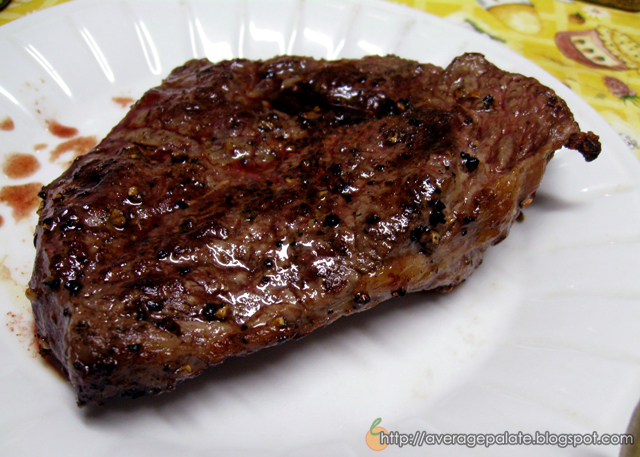
steak panfried and oven roasted

There are two main types of reactions responsible for the browning process:

1. Maillard reaction: a very complex set of reactions starting with an amino acid reacting with a sugar. I will explore this reaction in another post since it is omnipresent in cooking.

2. Pyrolysis: a complex series of reactions starting with the spontaneous breaking down of either carbohydrates or proteins due to high temperatures. Caramelization (oxidation of sugars) is a type of pyrolysis. Like with Maillard reactions, flavour and colour compounds are formed.

While both reactions are involved in browning foods, the Maillard reactions dominate by a large margin. The extent of each reaction depends on temperature, sugar content, protein content, etc.

Chefs and cooking enthusiasts often throw out terms like caramelization and the Maillard reaction, without differentiating the two. There seems to be a great deal of misunderstanding and confusion among online communities. The key point to remember is that both pyrolysis and Maillard reactions are involved, but it is the Maillard reactions that dominate.

I've recently read online posters claiming that Maillard reactions are not involved with the browning of meat due to the lack of sugars. They propose instead that the main player is pyrolysis. I have not been able to find a citation to support this. In fact, I have found experimental evidence of the contrary (see reference 2 at the end of the post). The problem with this claim is that there is an abundance of sugar in meats, as part of molecules found in cells (ATP, nucleic acids). Scientific literature I have read state that ribose, the sugar found in ATP and nucleic acids, is the major sugar participant in the Maillard reaction in the browning of meat. Hence, there's no reason to doubt there is enough sugar in meat for Maillard reactions.

So how does the browning process begin? With sufficient heat! The reactions involved occur most readily, or sometimes exclusively, at very high temperatures.

Heat is not the only requirement though. Food does not brown when it is boiled or steamed, even though there is a heat source. This is due to the presence of free water (ie: not water content in the meat). Non-enzymatic browning requires temperatures in excess of 100°C (boiling point of water). That means when a lot of water is present in liquid form, no browning can occur because water will take up all the heat and keep temperatures from exceeding 100°C. I drew up a little diagram in photoshop, mostly for fun.
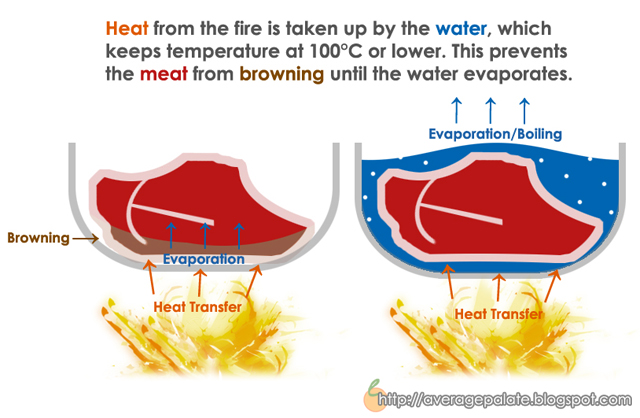
browning meat, Maillard, pyrolysis, caramelization
You might be wondering about the inherent water content in food. Since there's always water in food, why does browning occur at all? The answer is simple when we think about how it's only the exterior of what we are cooking that is browned. What happens is that as water evaporates from the food's surface, the temperature can increase increase to sufficient browning levels.

There's another reason why water inhibits the browning process besides temperature. The Maillard reaction produces water. If water is already present in the system (ie: your pot or pan), a reaction that produces water is less likely to occur. (Remember Le Chatelier's principle from high school chemistry?)

For the scientifically inclined:

Mottram DS (1998). Flavour formation in meat and meat products: a review. Food Chemistry 62(4), 415-424.

Pearson AM, Tarladgis BG, Spooner ME & Quinn JR (1966). The Browning Produced on Heating Fresh Pork II. The Nature of the Reaction. Journal of Food Science 31(2), 184-190.